


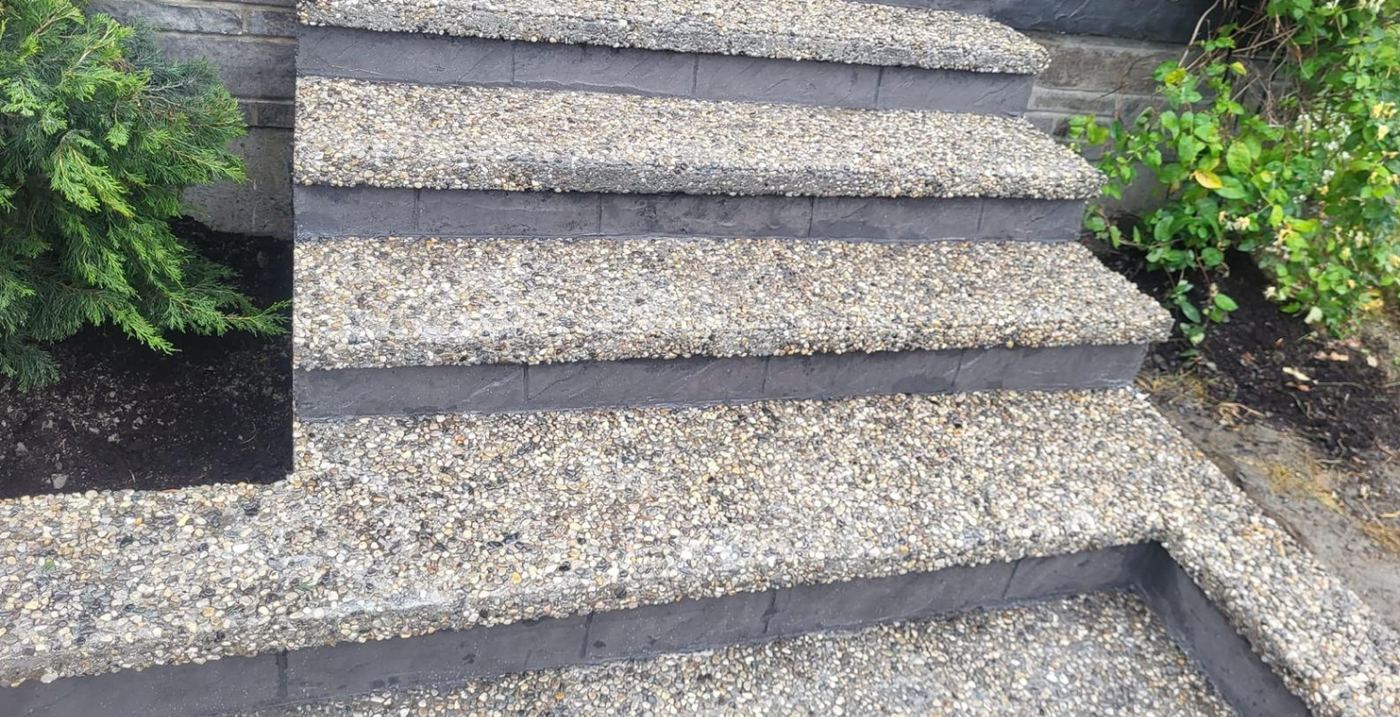
Three finishes cover most of what gets poured on residential driveways and patios here. They look different, they cost different, and — the part that rarely comes up at the quoting stage — they age differently under Ontario winters.
Broom finish
The standard. Concrete floated smooth, then dragged with a broom to leave a fine directional texture.
Salt and freeze-thaw: the most forgiving of the three, because there’s no decorative surface layer to lose and nothing imprinted to hold water. When the mix is air-entrained and cured properly, it’s the most durable option.
Traction: good. The texture is specifically there for grip.
Sealing: optional. Many broom driveways are never sealed and are fine.
Cost: lowest.
Downside: it looks like a concrete driveway.
Exposed aggregate
The surface mortar is washed or retarded away to expose the stone in the mix. You’re looking at the aggregate itself.
Salt and freeze-thaw: good, with a caveat. The exposed stone is hard and wears well, but the mortar matrix between stones is where de-icer attacks. Well-made exposed aggregate holds up; a badly cured one loses matrix and starts shedding stones.
Traction: excellent — the best of the three. Genuinely useful on sloped Hamilton Mountain driveways and on steps.
Sealing: wants it, roughly every 2–4 years. Sealer protects the matrix and keeps the stone colour rich; unsealed exposed aggregate goes flat and dusty-looking.
Cost: mid to high.
Downside: the texture that gives grip also catches dirt, and it’s less comfortable underfoot than a smooth surface. Fine for driveways and steps; think twice beside a pool.
Stamped concrete
Patterned mats pressed into fresh concrete, usually with integral colour and a release agent for contrast, to imitate stone, slate, brick or plank.
Salt and freeze-thaw: the most demanding of the three. The pattern creates low points that hold water and de-icer exactly where you don’t want it, and the surface colour layer is thin. Where stamped work fails early in Ontario it’s almost always de-icer plus an unsealed or poorly cured surface.
Traction: the weakest. Smooth-pattern stamped concrete plus sealer plus ice is slippery. Non-slip additive in the sealer is close to mandatory here, and we’d steer you away from a smooth slate pattern on a sloped driveway entirely.
Sealing: required, roughly every 2–3 years, and it’s not optional maintenance — it’s what protects the colour layer. Budget for it from day one.
Cost: highest of the three.
Upside: nothing else gets you that look at that price. A stamped patio under a covered porch, out of the salt, is a genuinely great choice and will last.
Our honest recommendation by location
Driveway that gets salted: broom finish, or exposed aggregate if you want something nicer. Stamped only if you commit to the sealing cycle and accept resealing as a cost of ownership.
Sloped driveway: exposed aggregate or broom. Not smooth stamped.
Front steps: exposed aggregate. Best traction of the three on the surface most likely to put someone on their back in January.
Rear patio, no de-icer: anything. This is where stamped earns its money.
Covered porch: anything, including smooth finishes that would be a bad idea in the open.
The thing that matters more than the finish
All three live or die on the same fundamentals: an air-entrained mix in the right exposure class, no water added on site, finishing after the bleed water has gone, and real curing.
A broom finish done badly fails faster than stamped done well. Pick the look you want, then make sure the quote specifies the mix and the curing — that’s the part that decides whether you’re happy in five years.