


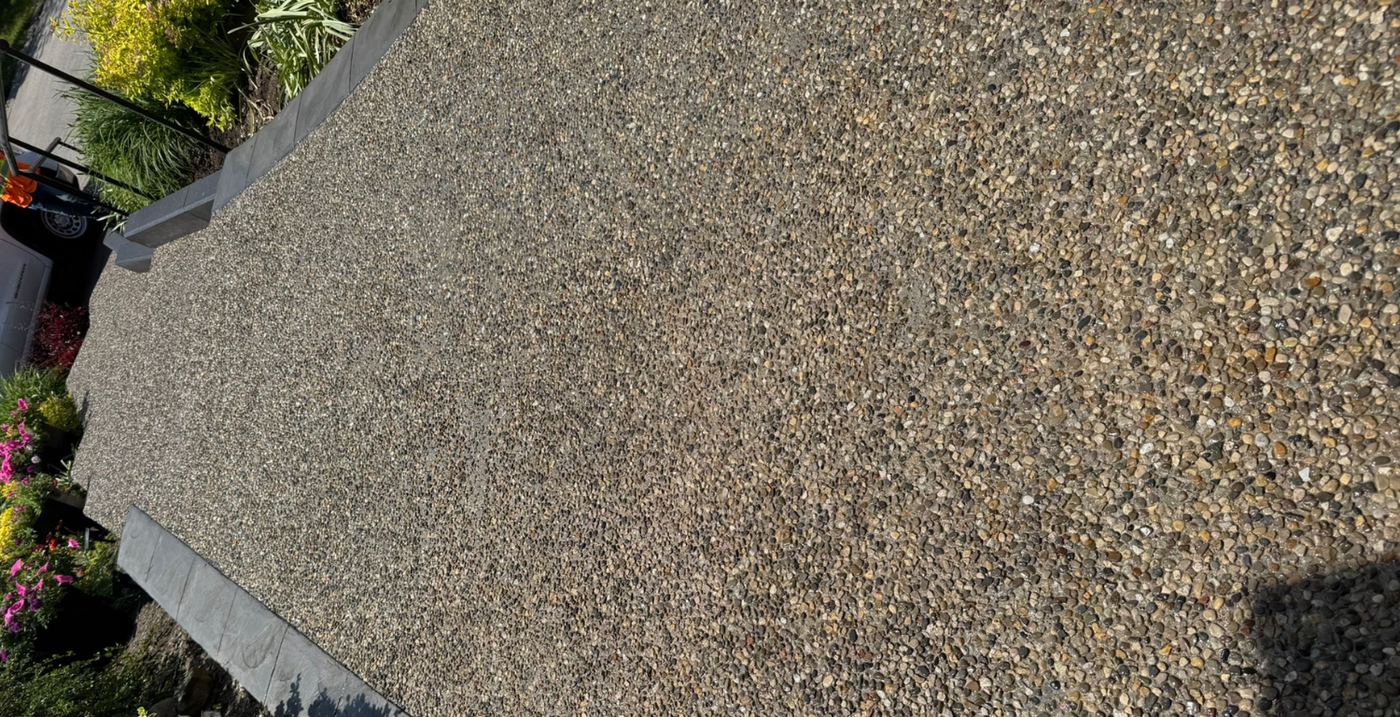
Spalling — the surface flaking off in sheets or popping out in small craters — is the most common complaint about residential concrete in this part of Ontario, and it tends to show up in the first spring after the pour.
Search it and you get page after page from sealing and restoration companies, all of which land in roughly the same place: freeze-thaw and road salt, so buy sealer. That’s not wrong, and it’s not the whole story. We install concrete rather than resurface it, so here’s the installer’s side — including the parts that are our responsibility.
What's physically happening
Water gets into the pores near the surface. It freezes, expands roughly 9%, and pushes. Thaw, repeat. Do that forty times a winter and the top few millimetres lose the argument.
De-icing salt makes it worse in two ways: it drives more cycles by melting and refreezing, and the salt solution itself creates osmotic pressure in the pore structure. That’s why the worst damage is always where the car drips.
Cause 1 — no air entrainment, or the wrong exposure class
Air-entrained concrete carries microscopic bubbles deliberately mixed in. They give freezing water somewhere to expand into. Without them, there’s nowhere for the pressure to go and the surface fails.
CSA defines exposure classes, and flatwork exposed to de-icing chemicals sits in the C-2 class, with requirements for air content and strength. An interior slab mix poured on a driveway will look identical on day one and fail in year one.
This one is on the contractor. If nobody asked what the slab was for and what it would meet, the mix was a guess.
Cause 2 — water added on site
Wetter concrete is easier to place and finish. It is also weaker and more porous, because the extra water leaves voids when it evaporates.
Watch a pour. If the crew is hosing into the truck or the chute to make it flow, the slab you’re getting is not the slab that was specified.
Contractor.
Cause 3 — finishing too early
Fresh concrete bleeds water to the surface. Troweling while that bleed water is still sitting there works it back into the top layer, creating a weak, high-water-content skin — exactly the layer that flakes off.
The discipline is waiting for the bleed water to evaporate before final finishing, even when the crew would like to go home.
Contractor.
Cause 4 — curing that didn't happen
Concrete needs moisture to keep hydrating. Left to dry out in sun or wind, the surface cures badly and stays weak. Curing compound, covering, or keeping it damp for the first several days is not optional.
Contractor.
Cause 5 — salt on first-winter concrete
Here’s the one that genuinely isn’t ours. Concrete keeps gaining strength and density for months. A slab poured in September meets its first winter young, and de-icing salt on it is the single most damaging thing a homeowner can do.
Use sand for traction the first winter. If you must de-ice, avoid rock salt — and never use anything containing ammonium sulphate or ammonium nitrate, which attack concrete directly.
Homeowner — but only if somebody told you. We put it in writing at handover, because an owner who wasn’t told can’t reasonably be blamed.
How to tell which one you've got
Uniform flaking across the whole slab, including areas that never saw salt — points at the mix, the finishing or the curing.
Damage concentrated where cars park and drip, or along the edge nearest the road — points at de-icer exposure.
Small popped craters with a stone at the bottom — that’s popouts, usually a porous aggregate particle, a materials issue.
Flaking in the first winter on a slab under a year old — whatever else is true, the mix or the curing is in question. Good concrete shouldn’t fail that fast even with salt on it.
What to ask before the next pour
Is the mix air-entrained, and what exposure class? What strength? Will water be added on site? When will it be cured and how? What’s the warranty on surface scaling, and what voids it?
A contractor who answers those without hesitating has thought about your driveway. One who says “it’s all the same concrete” has told you something useful.